Un-raveling the Tapestry: Human Involvement in Nature—Importance, Impacts, and Imperatives
Introduction
From the first controlled fire to the latest gene-edited crops, humanity’s résumé is stitched into the fabric of Earth’s ecosystems. Our species has the unrivaled ability to nurture landscapes and to push them to the brink—sometimes in the very same breath. Recognizing this duality is no mere philosophical exercise; it is prerequisite to charting a survivable future on a finite planet. (ipbes.net)
I. Why Human Involvement Matters (When We Get It Right)
Nature is not a distant postcard; it is an active life-support machine. Forests filter the air we breathe, wetlands buffer our cities from floods, and pollinators underwrite one out of every three bites of food. Economists bundle these gifts under the banner of ecosystem services, a term that politely declines to mention the mass panic that would erupt if the services were switched off. Embedded in many Indigenous stewardship systems—rotational harvests, sacred groves, agro-forestry—are time-tested proofs that involvement can be symbiotic rather than parasitic. (ipbes.net)
II. Climate Change: Turning Up the Thermostat
The Intergovernmental Panel on Climate Change reports that human activities have already warmed the planet by about 1.1 °C, amplifying droughts, super-charging hurricanes, and re-drawing the ranges of species from polar bears to disease-carrying mosquitoes. Anthropogenic greenhouse-gas emissions are now higher than at any point in at least the past 800,000 years—a dubious record no one is queuing up to celebrate. (ipcc.ch)
III. Deforestation and Habitat Loss: Subtracting Green from the Map
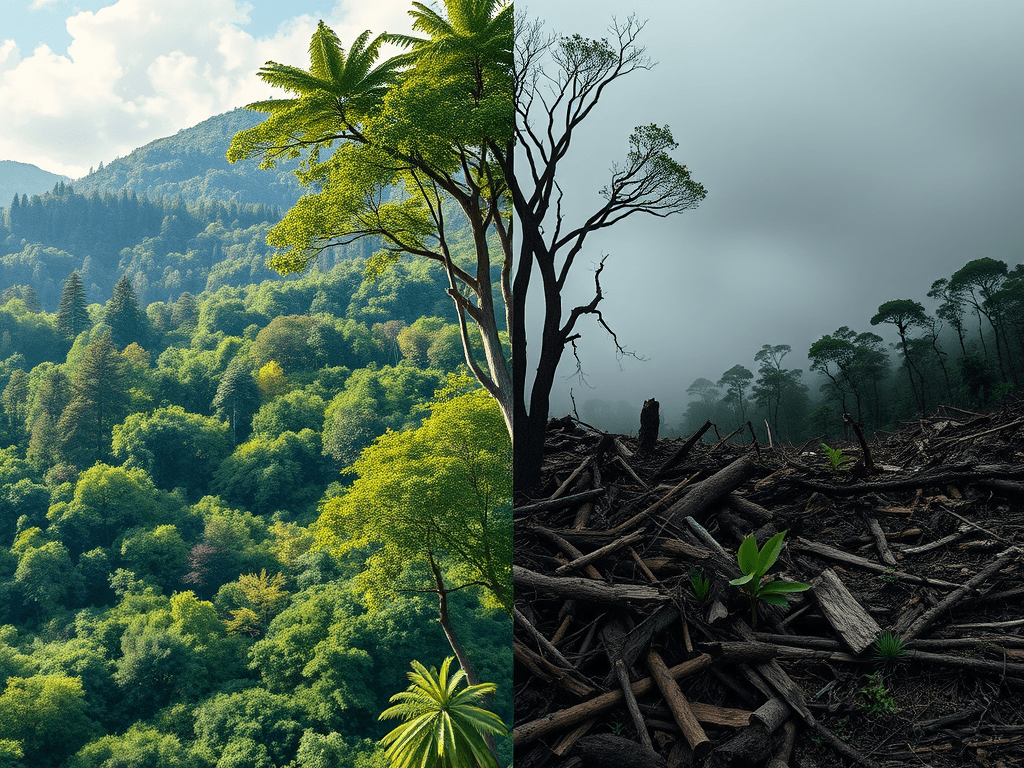
Trees do not merely stand in the way of progress; they are progress—storing carbon, manufacturing oxygen, and hosting incomprehensible webs of life. Yet between 1990 and 2020 the world posted a net loss of roughly 178 million hectares of forest, an area larger than Libya. While the annual rate of deforestation has slowed since the 1990s, the planet is still losing around 10 million hectares each year—as though we shred a soccer-pitch of forest every few seconds. (openknowledge.fao.org)
IV. Biodiversity Crash: The Silent Spring That Never Ends
When Rachel Carson rang the first global alarm bell in 1962, the Living Planet Index had not yet begun its grim descent; today it shows an average 73 % decline in monitored wildlife populations since 1970. IPBES warns that one million species face extinction, many within decades, largely due to land-use change, over-exploitation, pollution, and climate disruption—four horsemen we saddled ourselves. The loss is more than sentimental; it erodes food security, medicine discovery, and genetic insurance against future shocks. (livingplanet.panda.org, ipbes.net)
V. Pollution (with Plastic as Exhibit A)
Human ingenuity gave us polymers light enough for space travel and durable enough to last centuries—then we used them once to carry lunch. The United Nations Environment Programme estimates 19–23 million tonnes of plastic waste leak into aquatic ecosystems each year, the equivalent of 2,000 garbage trucks every single day. Micro-plastics now pepper Arctic snow and human placentas alike, proving that what happens in the checkout aisle no longer stays in the checkout aisle. (unep.org)
VI. Where Do We Go from Here?
The uncomfortable truth is that inaction is itself a form of involvement—and an expensive one. To bend the curve, societies must decarbonize energy, halt conversion of intact ecosystems, and embed “nature-positive” accounting into everything from city zoning to pension funds. Partnerships that center Indigenous and local knowledge consistently outperform fortress-style conservation, while rewilding experiments in Europe and North America show that giving nature elbow room can reboot entire food webs. Carbon credits, biodiversity offsets, and circular-economy legislation are tools, not silver bullets; wielded wisely, they buy time for natural systems to recover. (ipcc.ch)
Conclusion
Human involvement in nature is inevitable; the scoreboard simply records how we choose to participate. We can remain accidental arsonists of the only home we have—or we can graduate to the role of attentive gardeners, pruning excess, nurturing diversity, and remembering that every withdrawal from Earth’s ecological bank account accrues compound interest. The next chapter is unwritten, but the pen is unmistakably in our hands.
References
Intergovernmental Panel on Climate Change. (2023). Climate Change 2023: Synthesis Report. IPCC.
Intergovernmental Science-Policy Platform on Biodiversity and Ecosystem Services. (2019). Global Assessment Report on Biodiversity and Ecosystem Services. IPBES.
Food and Agriculture Organization of the United Nations. (2020). Global Forest Resources Assessment 2020: Key Findings. FAO.
United Nations Environment Programme. (2024). Plastic Pollution: UNEP Briefing Note. UNEP.
World Wide Fund for Nature. (2024). Living Planet Report 2024. WWF International.

 The Sarcastic Swede
Leave a comment